Is there such a thing as too much democracy?

Introduction
"With great power comes great responsibility..."
This phrase, attributed to the French author Voltaire in the eighteenth century but immortalized by Uncle Ben’s cautious warning to a young Peter Parker,[1] epitomizes the essence of democracy. The word “democracy” etymologically derives from the Greek words "demos,” meaning people, and "kratos,” meaning power. Thus, democracy is rooted in the "power of the people” – in Abraham Lincoln’s timeless words, a government of the people, for the people, and by the people. Often regarded as the most desirable form of government, democracy is popular largely because of the accountability that it fosters. Politicians, striving for election and subsequent re-election, need to garner public support to maintain their popularity. In turn, the common people must have the best interests of society at heart, because the small choices they make affect it at large. Both groups value this system, ranking it above governments in which the power is more concentrated, such as autocracy and oligarchy.
However, the very principles that make democracy appealing can also become its Achilles heel. To comprehend the potential pitfalls of excessive democracy, it is crucial to examine these foundational principles.
This essay argues that while democracy can be advantageous in moderation, an overabundance of it can lead to societal power imbalances between the people and their representatives, resulting in flawed and inefficient decision-making, ultimately undermining the effectiveness of governance and adversely affecting societal progress.
The Assumption of Rationality
Democracy, at its most basic definition, relies on the assumption that given the freedom to vote and participate in governance, individuals will make rational choices that reflect the best interests of society at large.[2] Any deviation from this assumption can lead to the potential pitfalls of this political system in excess.
Logical analysis of the motives behind political decisions and voters’ perspectives suggests that the assumption of citizen rationality is often unrealistic. Political engagement and political irrationality are demonstrably interconnected, as the fervent emotions that inspire civic involvement also intensify biases and polarization.[3] In essence, politics serves as a mechanism for individuals to realize their ideal society and actively work towards its realization. Consequently, people inevitably project their biases and personal perspectives through their political participation. Thus, a government devoid of some level of bias among its citizens would not be a true government at all.
A myriad of empirical evidence also combats assumptions about voter rationality. The Brexit referendum is a prime example of irrational behavior in democratic processes. Many Britons who voted for Brexit did so without fully understanding the political confusion and groundbreaking consequences that it would cause; the decision to leave was shaped more by emotional and historical influences rather than a rational cost-benefit analysis.[4] For instance, British citizens did not experience the same scale of devastation and loss of life as continental Europeans, leading to a different historical perspective on European integration. The British media’s frequent comparisons of EU initiatives to wartime events further fueled emotional responses. [5]
Moreover, the outcome of Brexit remained unchanged despite the significant economic costs associated with leaving the EU. For example, every major independent economic institution, such as the Bank of England and the IMF, issued warnings about the negative financial consequences of Brexit.[6] Despite these warnings, the majority of voters supported Brexit, highlighting the irrationality underlying their decisions.

Figure 1: Fluctuating support for the ‘Remain’ and ‘Leave’ camps over time highlights the volatility and emotional influences of voter decision-making (Source: Intereconomic.eu[7])
Looking back on Brexit, it is evident that the economic warnings by these banks were on point:[8]
In 2019, London's Gross Value Added, also known as GVA, was reduced by about 6.2% (£32 billion) compared to what it might have been if the UK had stayed in the EU since 2016. This shortfall translates to an average loss of nearly £9,500 in income per London household.
This essay focuses on the 2019 figures to exclude the impact of events like the COVID-19 pandemic, thereby attributing much of the economic shortfall to Brexit.
The UK currently has 1.8 million fewer jobs than it would have had without Brexit, representing a 4.8% decline. Specifically, in London, there are about 290,000 fewer jobs in 2023 than there would have been in a scenario where Brexit did not happen.
On average, Brexit has resulted in each Briton being nearly £2,000 poorer, while each Londoner has lost about £3,400 in income.
This referendum illustrates that political choices often deviate from rational decision-making. Voters prioritized ideological and emotional appeals over clear economic evidence and frequently shifted their positions over the span of six months, as shown in Figure 1. This underscores how excessive democracy can indeed lead to irrational outcomes, as too much decision-making responsibility is placed on a possibly uninformed public rather than on experts more likely to focus more on the viability and rationality of the decision rather than the emotional appeal.
Populist Policies
The rise of populist policies that prioritize short-term popularity over long-term fiscal responsibility is a clear indication of excessive democracy. A prime example of this is former United States President Donald Trump’s promise of tax cuts for billionaires prior to the 2024 United States Presidential Election. [9]
If democracy functioned as ideally envisioned, politicians would strive to benefit the nation to garner the support of the common people. However, expert analysis shows that Trump’s campaign promises (lower taxes, banning illegal immigration, etc.), while appealing to American voters, do not benefit America as a whole.
Projected Impact of Trump’s Campaign Promises on Key Economic Aspects vs. Current Levels | ||
Category | 2020-2024 (Current, Biden) | 2024-2028 (Projected, Trump) |
Real GDP (% Change) | 3.2 | 1.3 |
S&P Stock Price Index (% Change) | 12.7 | 4.2 |
Corporate Profits After Taxes (% Change) | 10.1 | 2.3 |
Federal Debt to GDP Ratio (%) | 98.4 | 108.2 |
Figure 2: Table (Based on data from economy.com) [10]
Extending the 2017 tax cuts and reducing the corporate tax rate is projected to increase the national budget deficit by approximately $4.7 trillion over the next decade.[11] Figure 3 (below) supports this affirmation; by 2028 Q4, the combined effect of these policies will result in a deficit increase of more than 1% of GDP compared to the baseline, indicating substantial long-term fiscal challenges. This illustrates a disconnect between Trump’s populist-appealing promises and the nation's long-term fiscal health.

Figure 3: Projected U.S. Budget Deficit Impact of Trump's Policy Proposals as a Percentage of GDP, 2024-2028 (Source: Economy.com[12])
Trump also suggested replacing the income tax with tariffs, which is a move that could lead to an additional cost of $5,000 per year for the average American family.[13] The chances of this additionally leading to increased inflation are very strong; in fact, sixteen Nobel Prize-winning economists have cautioned that Trump's proposals would not only fail to address inflation but would exacerbate the problem.[14]
As seen by the graph below, Trump’s policies, enacted under a Republican sweep, would increase unemployment, hindering the economic well-being of the average citizen.

Figure 4: Trump’s policies, under a Republican sweep, increase the employment rate considerably (Source: Economy.com[15])
Indeed, Trump’s tax cuts disproportionately benefit the demographic most financially capable of contributing to his campaign, while offering minimal assistance and potentially hindering progress for those less affluent.
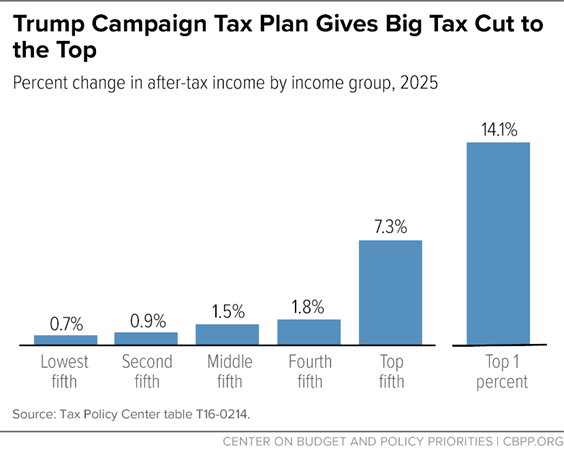
Fig. 5: Trump’s tax cut promises disproportionately benefit the wealthy while minimally changing the after-tax income of the middle to lower class (Source: cbpp.org) [16]
As proved, Trump’s promises do not benefit the common citizen. The motive behind his promises is to play to the favorable populist perception towards his policies and to prioritize the rich, although such measures are detrimental to the United States and its common people in the long run.
This situation illustrates how democracy, rather than incentivizing politicians to work for the common good, can create inequities by encouraging them to appeal to wealthy benefactors at the expense of the average citizen. By overemphasizing the power that citizens hold, democracy fosters a hierarchy where individuals are judged not on their intrinsic value but on their influence and financial contributions as voters.
Decision-Making Inefficiency
Another significant challenge often correlated with excessive democracy is decision-making inefficiency. While democratic mechanisms aim to evenly distribute power among the people and their representatives, they can lead to considerable delays in policy implementation because democracy strives for the consensus of the majority. This inefficiency is particularly dangerous in situations that require swift and decisive action.
The debate on extending the debt ceiling deadline serves as a prime example of such inefficiency. The debt ceiling, a legislative cap on the amount of national debt that can be incurred by the U.S. Treasury[17], requires periodic approval from Congress to be raised or suspended.[18] This process, intended to ensure fiscal responsibility, often devolves into a battleground for partisan politics. As a result, the American public witnesses numerous adverse consequences.
The year 2011 saw taxpayers collectively lose almost $1.3 billion in the same fiscal year because of delays in lifting the debt ceiling and approximately $19 billion over ten years.[19] Even further, Treasury officials noted that the heightened focus on debt limit-related operations during these delays necessitated more time and resources, diverting Treasury staff from other crucial cash and debt management responsibilities.[20]
The stock market also experienced significant turmoil during the 2011 debt limit debate. The Dow Jones Industrial Average plummeted approximately 2,000 points from late July to early August, with one of its most severe single-day drops occurring on August 8, when it fell 635 points following the S&P downgrade.[21]

Figure 6: The S&P 500 plummeted to new lows since 2008 as a result of the debates over extending the debt ceiling (Source: money.cnn.com[22])
The extended and politically charged debt limit standoff in the summer of 2011 led Standard & Poor’s to make the unprecedented decision to downgrade the U.S. credit rating from its triple-A status[23], diminishing investor confidence in government functionality and compelling demand for higher interest rates for loans.[24]
This recurring conflict between parties over whether or not to raise the debt limit is ultimately unproductive, as Congress has historically always acted to raise the debt limit when necessary, regardless of partisan opinions.[25] While raising the debt ceiling is not an ideal solution, it is realistically the only viable solution, as the only other choice is defaulting on the United States’s debt.[26]
Despite the clear choice, the unnecessary partisan arguments that occur each time this issue arises result in wasted time and resources, heavily increased costs for taxpayers, and financial instability. These avoidable repercussions stem from the unnecessary conflicts between parties inherent in a democratic government, illustrating the excessive democracy present when this form of governance is applied to problems that require immediate action.
Conclusion
As John Locke himself posited, the primary role of government is to protect the lives and property of its citizens, maintaining a balance between freedom and order, and should be confined to such[27]. As a liberalist, Locke believed that government is necessary to protect individuals from being harmed by others but also recognized that the government itself can pose a threat to liberty in extreme cases.[28] A tempered democracy enables citizens to influence governance while mitigating the drawbacks of excessive public power, thereby fostering a stable and effective government.
Therefore, in summary, the notion of excessive democracy is not only plausible but also detrimental. While democratic principles are vital for ensuring accountability and public engagement, an overabundance of democracy can result in irrational decision-making, populist policies, and inefficient governance. It is not only the spirit of inequality, but also the spirit of extreme equality, that can lead to democratic excess.[29]
[1] Izen, Irwin S. “With Great Power Comes Great Responsibility.” New York Law Journal, New York Law Journal, 6 Mar. 2023, https://www.law.com/newyorklawjournal/2023/03/06/with-great-power-comes-great-responsibility/.
[2] Lee, I-Ching, et al. “Are We Rational or Not? The Exploration of Voter Choices during the 2016 Presidential and Legislative Elections in Taiwan.” Frontiers in Psychology, U.S. National Library of Medicine, 12 Oct. 2017, www.ncbi.nlm.nih.gov/pmc/articles/PMC5643908/.
[3] Ancell. “Political Irrationality, Utopianism, and Democratic Theory.” Sage Journals, 6 Dec. 2019, journals.sagepub.com/doi/full/10.1177/1470594X19889108#body-ref-bibr6-1470594X19889108.
[4] Pfeiffer, Chloe. “Economist: Brexit Is a Perfect Example of Irrational Behavior.” Business Insider, Business Insider, www.businessinsider.com/thaler-brexit-shows-irrational-behavior-2016-6. Accessed 22 June 2024.
[5] Elavhobe. “Brexit: The Invasion of Irrationality.” ICDS, 6 Aug. 2020, icds.ee/en/brexit-the-invasion-of-irrationality/.
[6] “IMF Says Brexit ‘Pretty Bad to Very, Very Bad.’” BBC News, BBC, 13 May 2016, www.bbc.com/news/business-36284200#:~:text=Former%20Treasury%20minister%20Lord%20Myners,we%20cannot%20afford%20to%20take.%22.
[7] Qvortrup, Matt. “Brexit as an Inelastic Good: A Microeconomic Theory of Direct Democracy.” Intereconomics, 1 Jan. 1970, www.intereconomics.eu/contents/year/2016/number/5/article/brexit-as-an-inelastic-good-a-microeconomic-theory-of-direct-democracy.html.
[8] “New Report Reveals UK Economy Is Almost £140 Billion Smaller Because of Brexit.” London City Hall, 31 Jan. 2024, www.london.gov.uk/new-report-reveals-uk-economy-almost-ps140billion-smaller-because-brexit.
[9] Perez, Andrew. “As Trump Promises Donors Big Policy Favors, Cash Pours In.” Rolling Stone, Rolling Stone, 21 June 2024, www.rollingstone.com/politics/politics-news/trump-promises-donors-policy-favors-cash-super-pac-1235043839/.
[10] Zandi, Mark M., et al. “Assessing the Macroeconomic Consequences of Biden Vs. ...” Economy.Com, Moody’s, www.economy.com/getfile?q=EA99E998-560D-4A12-85DE-3727A7EBE9A8&app=download. Accessed 24 June 2024.
[11] Soisson, Isabel. “Trump Promises Billionaires Tax Cuts If They Donate to His Campaign.” Cardinal & Pine, 18 June 2024, cardinalpine.com/2024/06/18/trump-billionaires-tax-cuts/.
[12] Zandi, Mark M., et al. “Assessing the Macroeconomic Consequences of Biden Vs. ...” Economy.Com, Moody’s, www.economy.com/getfile?q=EA99E998-560D-4A12-85DE-3727A7EBE9A8&app=download. Accessed 24 June 2024.
[13] Soisson, Isabel. “Trump Promises Billionaires Tax Cuts If They Donate to His Campaign.” Cardinal & Pine, 18 June 2024, cardinalpine.com/2024/06/18/trump-billionaires-tax-cuts/.
[14] Egan, Matt. “Trump Would Make America’s Inflation Crisis Worse, 16 Nobel Economists Warn | Cnn Business.” CNN, Cable News Network, 26 June 2024, www.cnn.com/2024/06/26/business/nobel-economists-trump-inflation.
[15] Zandi, Mark M., et al. “Assessing the Macroeconomic Consequences of Biden Vs. ...” Economy.Com, Moody’s, www.economy.com/getfile?q=EA99E998-560D-4A12-85DE-3727A7EBE9A8&app=download. Accessed 24 June 2024.
[16] Chye-Ching Huang, Chye-Ching Huang. “Revised Trump Tax Plan Not Revised Enough.” Center on Budget and Policy Priorities, 27 Apr. 2017, www.cbpp.org/blog/revised-trump-tax-plan-not-revised-enough.
[17] “United States Debt Ceiling.” Wikipedia, Wikimedia Foundation, 6 May 2024, en.wikipedia.org/wiki/United_States_debt_ceiling.
[18] Elving, Ron. “Congress Is Seeking (Its Own) Permission to Borrow Another Trillion or Two.” NPR, NPR, 24 Sept. 2021, www.npr.org/2021/09/24/1031701538/congress-debt-ceiling-explainer.
[19] “U.S. Debt Ceiling: Costs and Consequences.” PBS, Public Broadcasting Service, 4 Jan. 2013, www.pbs.org/newshour/politics/debt-ceiling-1.
[20] Office, U.S. Government Accountability. “Debt Limit: Analysis of 2011-2012 Actions Taken and Effect of Delayed Increase on Borrowing Costs.” Debt Limit: Analysis of 2011-2012 Actions Taken and Effect of Delayed Increase on Borrowing Costs | U.S. GAO, 9 Nov. 2015, www.gao.gov/products/gao-12-701.
[21] “U.S. Debt Ceiling: Costs and Consequences.” PBS, Public Broadcasting Service, 4 Jan. 2013, www.pbs.org/newshour/politics/debt-ceiling-1.
[22] Yousuf, Hibah. “Market Report.” CNNMoney, Cable News Network, 30 Dec. 2011, money.cnn.com/2011/12/30/markets/markets_newyork/index.htm.
[23] “U.S. Debt Ceiling: Costs and Consequences.” PBS, Public Broadcasting Service, 4 Jan. 2013, www.pbs.org/newshour/politics/debt-ceiling-1.
[24] “U.S. Debt Ceiling: Costs and Consequences.” PBS, Public Broadcasting Service, 4 Jan. 2013, www.pbs.org/newshour/politics/debt-ceiling-1.
[25] “Debt Limit.” U.S. Department of the Treasury, 21 Aug. 2023, home.treasury.gov/policy-issues/financial-markets-financial-institutions-and-fiscal-service/debt-limit#:~:text=Congress%20has%20always%20acted%20when,29%20times%20under%20Democratic%20presidents.
[26] “Q&A: Everything You Should Know about the Debt Ceiling.” Committee for a Responsible Federal Budget, www.crfb.org/papers/qa-everything-you-should-know-about-debt-ceiling. Accessed 22 June 2024.
[27] Moseley, Alexander. “John Locke: Political Philosophy.” Internet Encyclopedia of Philosophy, iep.utm.edu/locke-po/. Accessed 22 June 2024.
[28] “Liberalism.” Encyclopedia Britannica, Encyclopedia Britannica, inc., 18 June 2024, www.britannica.com/topic/liberalism.
[29] Zumbrunnen, John. “Montesquieu, Spirit of the Laws.” ADEF 20182019 Republicanism Federalism and the US Constitution, wisc.pb.unizin.org/adef20182019/chapter/4-rousseau/. Accessed 28 June 2024.
Comments